
Should We Rewrite the Constitution?
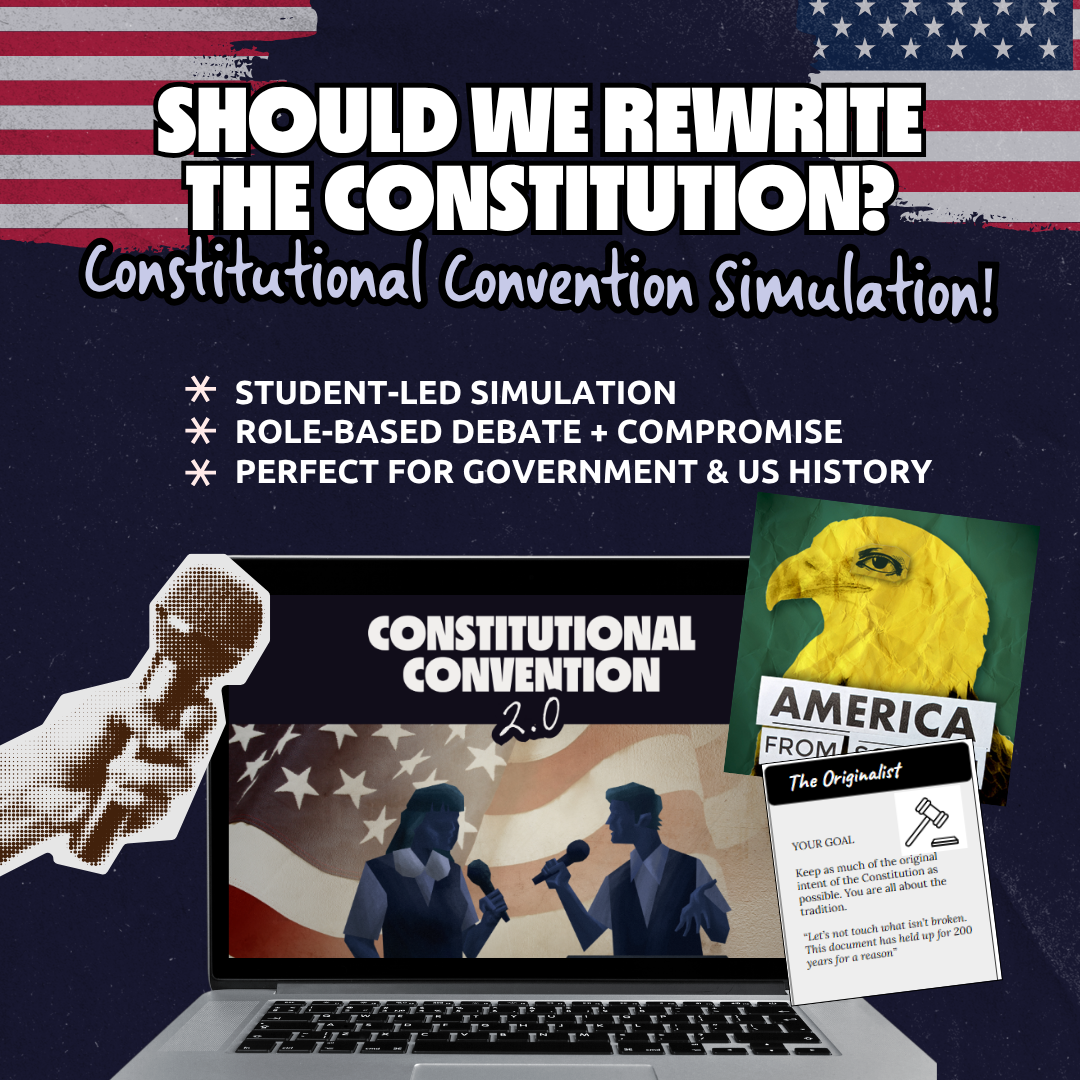
This low-prep constitutional simulation for high school Government and US History puts students back in the room where it happened, except this time it’s their generation making the call.
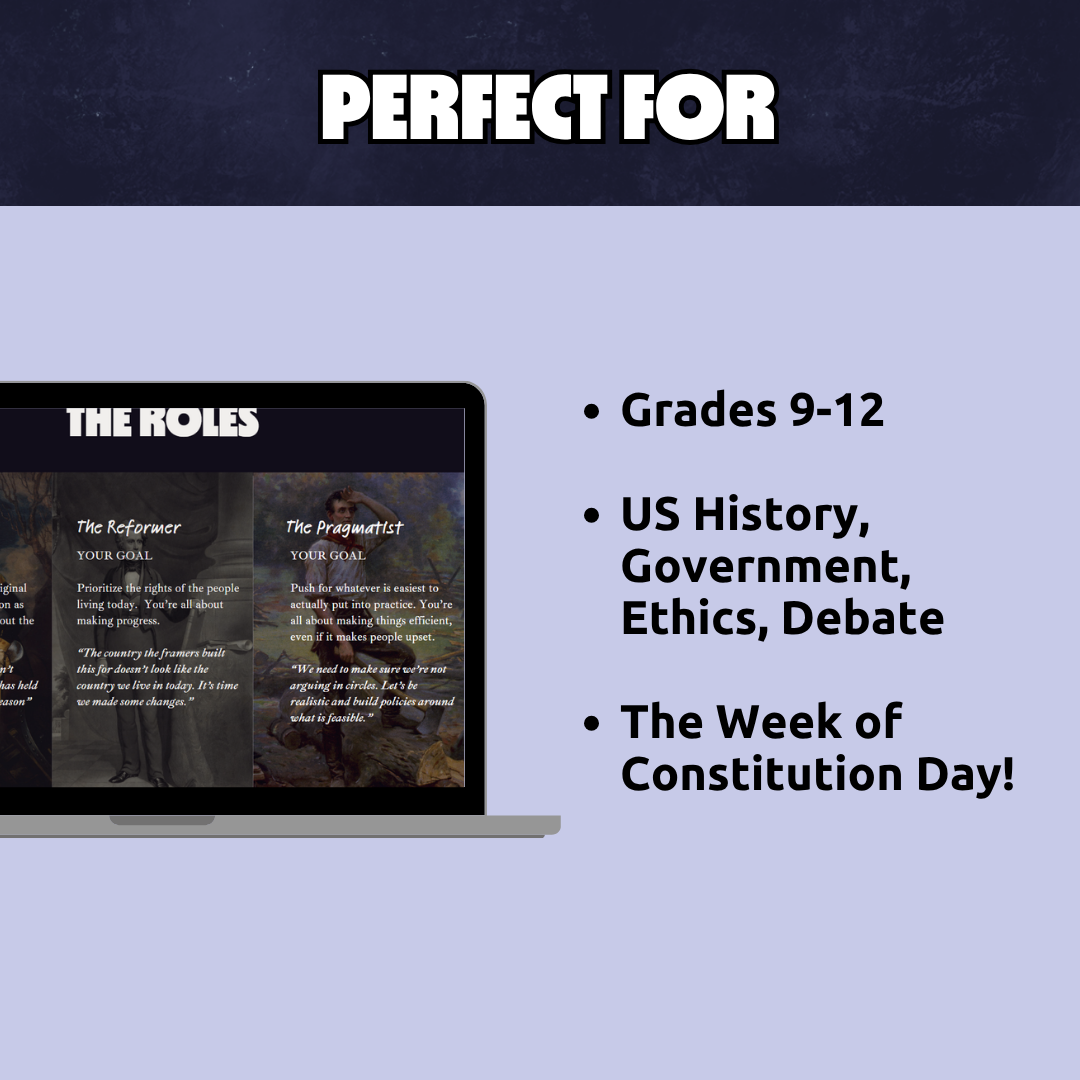
Students take on one of three roles: the Originalist protects tradition, the Reformer pushes for the people living today, and the Pragmatist just wants something that works. They work through real constitutional debates broken into decision-ready parts, negotiate as a group, and watch the whole class build one collective “Constitution 2.0” live.
BADGES: Editable Google Slides | Low prep | Grades 9-12 | Role-play simulation | Government, Civics, US History, Ethics
HOW IT WORKS:
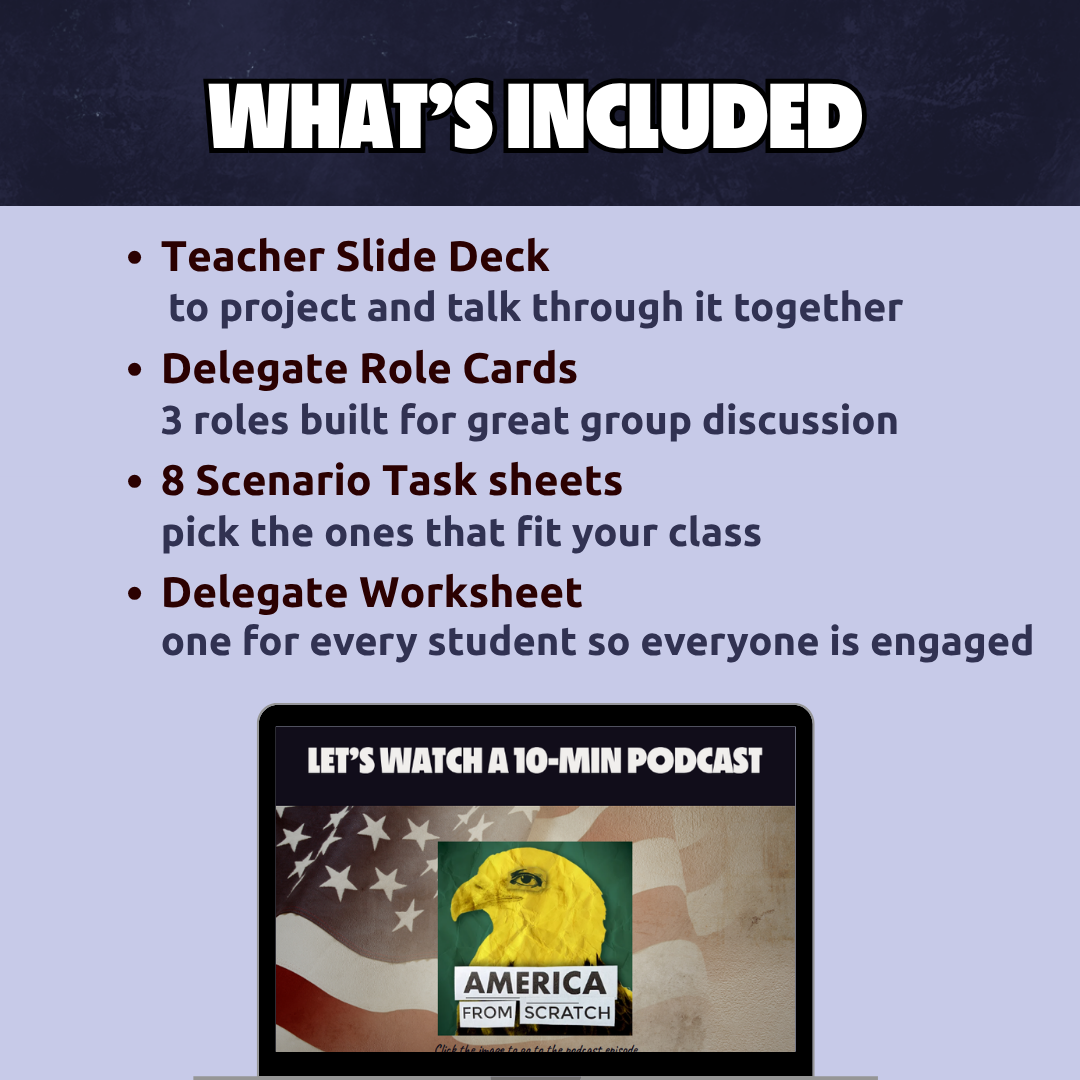
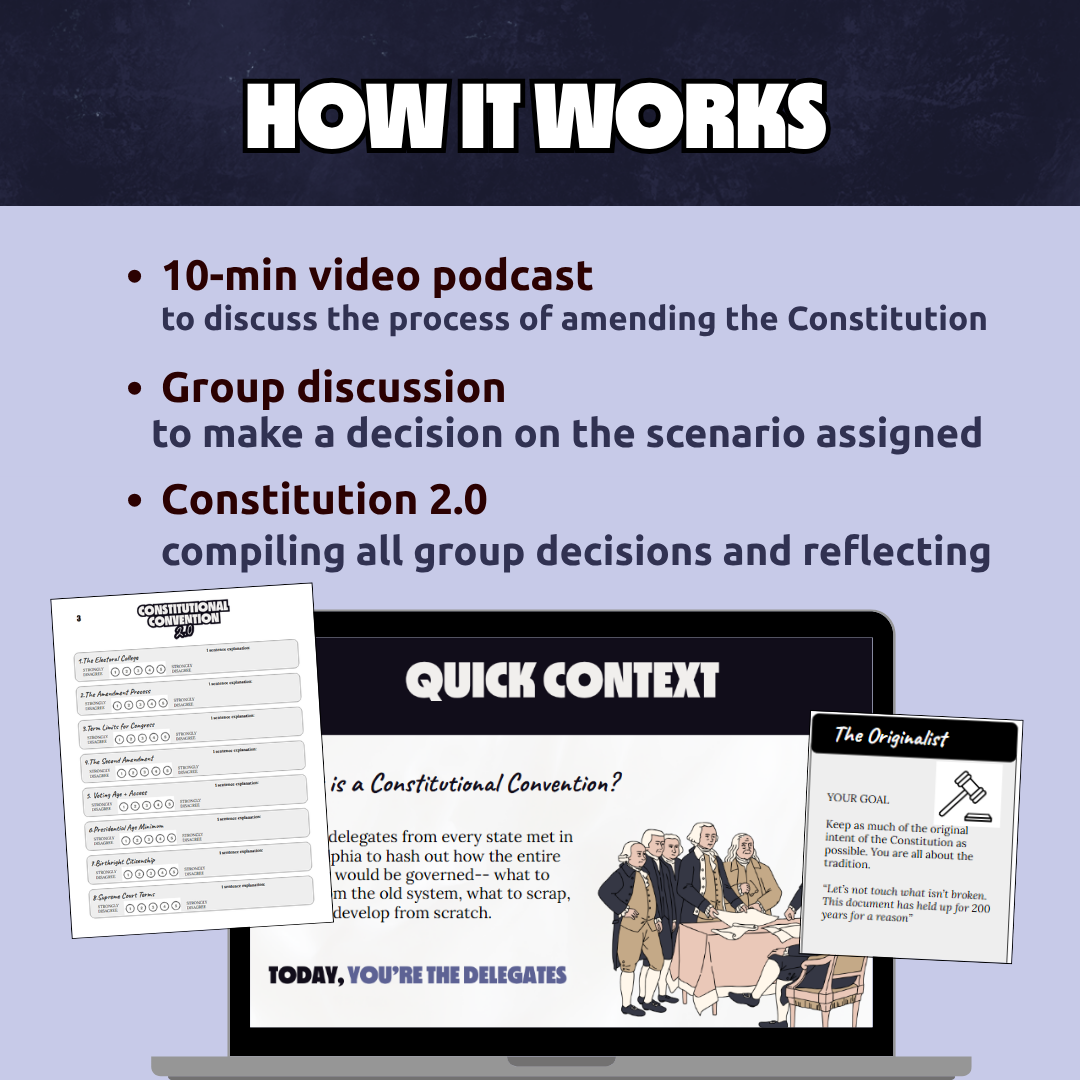
Quick warm-up and context. Students start with a short podcast episode (America From Scratch) and a quick explainer on what a constitutional convention actually is, so they walk in understanding the stakes.
Get into role. Groups of 3 each take on a role with a built-in goal and voice.
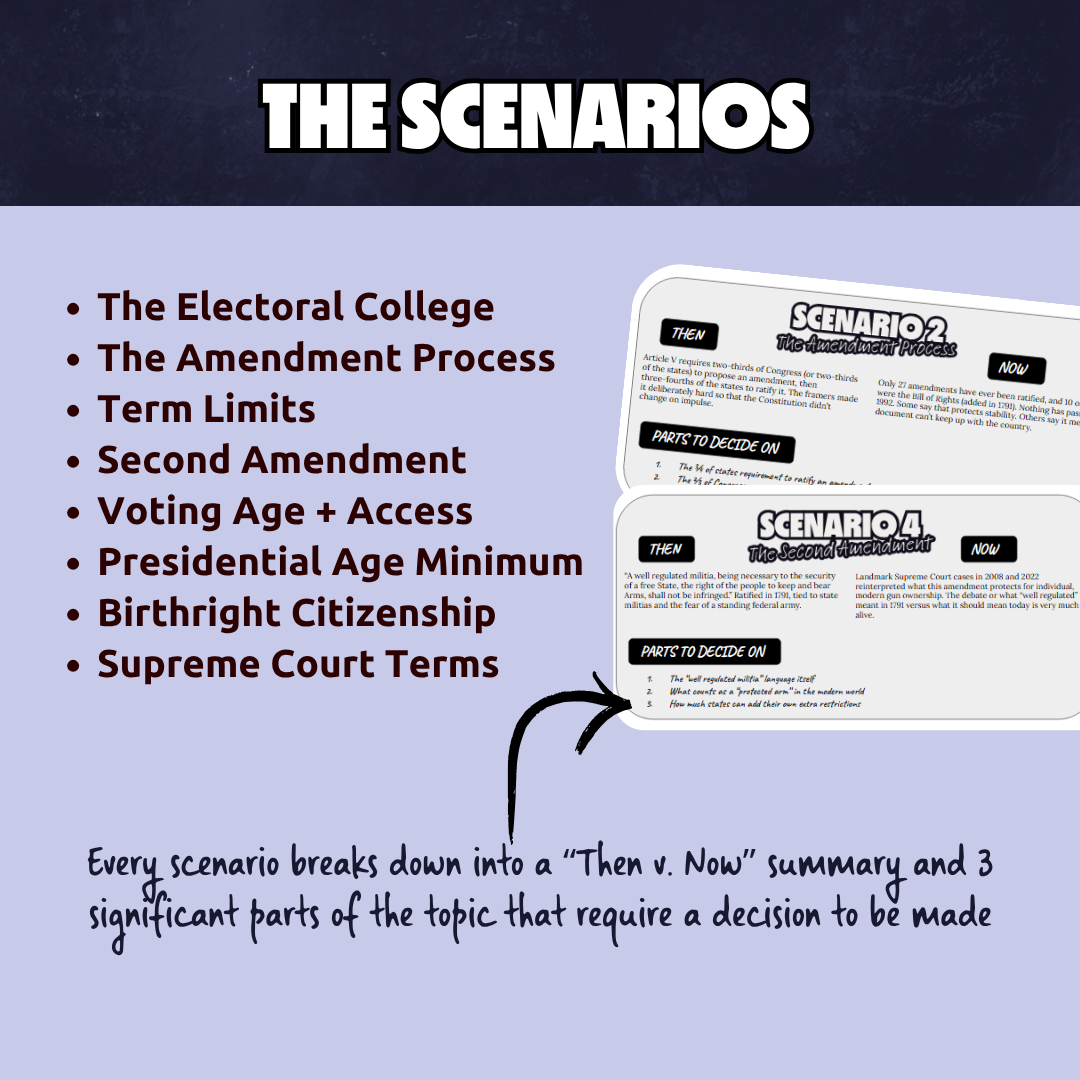
Work the scenarios. Every group gets 1-2 scenario task sheets (you know your kids, so you pick how many). Each one has a “Then” and “Now” summary of the debate, plus 3 specific parts the group must actually decide on.
Compile and debrief. Groups report their official call live, and the class builds one shared “Constitution 2.0” before debriefing on where the disagreements really were. Have each group build a slide with their decision, or have them come up to the board to write it and sign it, whichever feels right.
Delegate worksheet. Every student records their role’s reasoning and their group’s final call for each scenario, then reflects by rating how much they agree with every group’s decision on a 5-point scale and explaining why.
WHAT’S INCLUDED:
Warm-up and constitutional convention explainer
Role cards for the Originalist, the Reformer, and the Pragmatist
8 scenario task sheets: the Electoral College, the Amendment Process, Term Limits, the Second Amendment, Voting Age and Access, Presidential Age Minimum, Birthright Citizenship, and Supreme Court Terms
“Then” and “Now” summaries and 3 decision parts for every scenario
“Constitution 2.0” compile slides and debrief
Delegate worksheet with a written reflection
Editable Google Slides
EASY TO ADAPT:
Use all 8 scenarios across the class, or hand-pick the ones your students can handle
Run it in one period, or stretch the debrief into day two
Customize any directions, scenarios, or wording in the editable Google Slides
Reuse the same role cards and format with new scenarios all year
WHO IS THIS ACTIVITY FOR?
High school Government, Civics, US History, and Ethics classes (grades 9-12)
Your Constitution unit or Constitution Day (September 17)
Any time your curriculum touches on amendments, founding documents, or whether 200-year-old institutions still serve the people they govern
Any class where students should think critically about the documents that shape American life
STUDENT SKILLS:
Argue a fixed position and defend it using real historical and modern context
Break a broad debate into specific, decidable parts instead of vague opinions
Practice negotiation and compromise inside their own group, then evaluate other groups’ decisions
Connect constitutional principles (Electoral College, amendment process, judicial terms) to live, current debates
Reflect in writing on where they agree, where they’d push back, and why
MAKE IT YOUR OWN:
The Google Slides are editable, so you can change any directions, scenarios, or wording to fit your class. Swap in new scenarios and reuse the role cards all year.
REFUNDS:
Due to the nature of digital products, all sales are final and refunds are not available. Please review the product description and preview images carefully before purchasing. If you have trouble accessing your files, contact me at drea@deeplyhumanteaching.com and I’ll help resolve it.
This low-prep constitutional simulation for high school Government and US History puts students back in the room where it happened, except this time it’s their generation making the call.
Students take on one of three roles: the Originalist protects tradition, the Reformer pushes for the people living today, and the Pragmatist just wants something that works. They work through real constitutional debates broken into decision-ready parts, negotiate as a group, and watch the whole class build one collective “Constitution 2.0” live.
BADGES: Editable Google Slides | Low prep | Grades 9-12 | Role-play simulation | Government, Civics, US History, Ethics
HOW IT WORKS:
Quick warm-up and context. Students start with a short podcast episode (America From Scratch) and a quick explainer on what a constitutional convention actually is, so they walk in understanding the stakes.
Get into role. Groups of 3 each take on a role with a built-in goal and voice.
Work the scenarios. Every group gets 1-2 scenario task sheets (you know your kids, so you pick how many). Each one has a “Then” and “Now” summary of the debate, plus 3 specific parts the group must actually decide on.
Compile and debrief. Groups report their official call live, and the class builds one shared “Constitution 2.0” before debriefing on where the disagreements really were. Have each group build a slide with their decision, or have them come up to the board to write it and sign it, whichever feels right.
Delegate worksheet. Every student records their role’s reasoning and their group’s final call for each scenario, then reflects by rating how much they agree with every group’s decision on a 5-point scale and explaining why.
WHAT’S INCLUDED:
Warm-up and constitutional convention explainer
Role cards for the Originalist, the Reformer, and the Pragmatist
8 scenario task sheets: the Electoral College, the Amendment Process, Term Limits, the Second Amendment, Voting Age and Access, Presidential Age Minimum, Birthright Citizenship, and Supreme Court Terms
“Then” and “Now” summaries and 3 decision parts for every scenario
“Constitution 2.0” compile slides and debrief
Delegate worksheet with a written reflection
Editable Google Slides
EASY TO ADAPT:
Use all 8 scenarios across the class, or hand-pick the ones your students can handle
Run it in one period, or stretch the debrief into day two
Customize any directions, scenarios, or wording in the editable Google Slides
Reuse the same role cards and format with new scenarios all year
WHO IS THIS ACTIVITY FOR?
High school Government, Civics, US History, and Ethics classes (grades 9-12)
Your Constitution unit or Constitution Day (September 17)
Any time your curriculum touches on amendments, founding documents, or whether 200-year-old institutions still serve the people they govern
Any class where students should think critically about the documents that shape American life
STUDENT SKILLS:
Argue a fixed position and defend it using real historical and modern context
Break a broad debate into specific, decidable parts instead of vague opinions
Practice negotiation and compromise inside their own group, then evaluate other groups’ decisions
Connect constitutional principles (Electoral College, amendment process, judicial terms) to live, current debates
Reflect in writing on where they agree, where they’d push back, and why
MAKE IT YOUR OWN:
The Google Slides are editable, so you can change any directions, scenarios, or wording to fit your class. Swap in new scenarios and reuse the role cards all year.
REFUNDS:
Due to the nature of digital products, all sales are final and refunds are not available. Please review the product description and preview images carefully before purchasing. If you have trouble accessing your files, contact me at drea@deeplyhumanteaching.com and I’ll help resolve it.